
THE THREAT TO LGBTQ+ RIGHTS AS USAID TERMINATES FUNDING
Since the 18th century, international aid has been crucial in advancing human rights, healthcare, and economic development worldwide. For LGBTQ+ communities, especially in regions where discrimination is legalized, funding from donors such as USAID has been a lifeline for access to healthcare, legal protections, and advocacy. However, a sudden shift in U.S. policy has put this support at risk, as USAID has terminated most of its funding to Uganda.
As one of the largest contributors to global development assistance, the U.S. government’s decision directly disrupts LGBTQ+ rights efforts in Uganda. The ripple effects could lead to significant setbacks for critical programs and services. Without USAID support, organizations that rely on this funding face existential threats.
USAID has been instrumental in funding HIV prevention, treatment, and care programs specifically addressing the needs of LGBTQ+ individuals. Many organizations have relied on this support to challenge the HIV/AIDS crisis and provide mental health services. Without this funding, many programs may shut down, increasing the risk of a major health crisis.
Many organizations in Uganda receive direct funding from USAID to provide legal aid, shelter, and emergency assistance for LGBTQ+ individuals in crisis. This funding also enables advocacy efforts to challenge discriminatory laws. Without USAID’s financial backing, these legal and advocacy initiatives will be significantly weakened, leaving LGBTQ+ individuals more vulnerable to persecution.
USAID funding has not just been about financial assistance, it has also been a tool of diplomatic pressure. It has supported human rights documentation, legal defense efforts, and campaigns against anti-LGBTQ+ legislation. Without this support, the Ugandan government may feel motivated to escalate repression without fear of international consequences.
The termination of USAID funding will have serious consequences, but mostly, health crises because LGBTQ+ individuals already face discrimination in healthcare. Without USAID funding, access to HIV treatment, PrEP, and mental health services will decline. LGBTQ+ health centers that relied on USAID support may be forced to shut down, leaving many without safe and affirming healthcare options.
Moving Forward, while the loss of USAID funding presents an urgent challenge, LGBTQ+ communities must adapt by building resilience and reducing dependency on Western aid. Here’s what we think;
LGBTQ+ organizations should actively seek support from smaller, independent foundations, private sector donors, and regional funding mechanisms. African philanthropists, diaspora communities, and impact investors can play a greater role in sustaining the cause.
LGBTQ+ groups across Africa and beyond must collaborate, sharing resources, strategies, and emergency assistance. Regional funding models that do not rely solely on Western aid should be prioritized to ensure long-term sustainability.
Even with the loss of USAID support, the fight for legal protections must continue at the grassroots level. LGBTQ+ organizations should work with remaining allies to push for policy reforms and engage in local advocacy efforts to ensure legal and social protections.
Additionally, building economic resilience is essential. LGBTQ+ organizations should establish skills training programs, entrepreneurship initiatives, and financial independence projects. By supporting LGBTQ+ individuals in gaining economic stability, the community can reduce reliance on external donors.
Finally, LGBTQ+ organizations ought to start self-sustaining community initiatives. Such as housing cooperatives, crowdfunding models, and solidarity funds that can provide direct support to those in crisis.
LGBTQ+ rights should not depend entirely on international aid, but the reality is that for many, USAID funding has been a lifeline. With this support now terminated, LGBTQ+ movements must adapt, innovate, and build more self-sufficient structures. History has shown that even in the face of uncertainty, LGBTQ+ communities find ways to resist, survive, and thrive. Now is the time.
Read MoreBisexuality Is Not a Phase: Dispelling the Myth of Transitioning to Being Gay
There’s a harmful myth that bisexuality is just a stopover on the way to being gay or lesbian. For years, bisexual people have and continue to face the misconception that their identity is temporary, a transition phase before they “fully” come out as gay. But this idea is false and damaging. Let’s explore why bisexuality is a valid, stable identity and how the myth of transitioning does more harm than good.
Many people believe that bisexual individuals are simply “not ready” to come out as gay or lesbian. This comes from a misunderstanding of bisexuality and reinforces the false belief that attraction must be exclusive to one gender. It suggests that bisexuality is a halfway point, a stop on the road to a monosexual identity. But this narrative erases the experiences of bisexual people and dismisses their identity as something less than real.
Bisexuality is a legitimate sexual orientation. It is attraction to more than one gender, and this identity is stable for many people. Studies have shown that bisexuality is not a transitional phase; it’s an enduring orientation for those who identify with it. Bisexual people are just as likely to form long-term relationships as their gay or straight counterparts, and their relationships whether with people of the same gender or a different gender do not negate their bisexuality.
It’s important to recognize that bisexuality isn’t about indecision or confusion. It’s about recognizing the capacity for attraction beyond the binary of gay or straight.The idea that bisexual people are simply on a journey toward being gay or lesbian leads to bisexual erasure, where the existence of bisexuality is denied or ignored. It fosters biphobia, not only from the straight community but also from within the LGBTQ+ community, where bisexual people are sometimes viewed with skepticism or mistrust.
This narrative also causes significant self-doubt for many bisexual people, especially when they are pressured to “choose a side.” Being told that their identity is not real can lead to feelings of invalidation, confusion, and even shame.
Bisexual people deserve recognition for who they are, without questioning their identity or assuming it will evolve into something else. By sharing stories of bisexual people in long-term relationships, stable careers, and fulfilling lives, we can help dismantle the myth that bisexuality is a phase.
Read MoreThe Intersection of Religion, Sexuality, and Mental Health
This month of May is Mental Health Awareness Month all around the world. Mental Health is an important discussion that must be had all year round. A study done by BMJ Global Health in Uganda last year revealed that approximately 14 million people out of a population of 43.7 million, or about 32.0%, were affected by mental illness in 2022 and this number has gone up over time[1]. Individuals who identify as LGBTQI+ and belong to a religious community suffer even more. Mental health is an important aspect of overall well-being, and for many LGBTQI+ individuals, it intersects with their experiences of faith in profound ways.
With 98% of Uganda’s population subscribing to a religion[2], religious affiliation is beyond a practice, it’s almost an identity deeply interwoven in who they are. Individuals who identify as LGBTQI+ struggle with existing in their true sexual identity and their religion simultaneously. Feelings of conflict, rejection, or alienation, both internally and within their religious or spiritual communities rise as a result of the homophobic teachings or expectations of their faith traditions, these create significant emotional distress and strain on their mental well-being. For example;
The past 2 years have been extreme for the LGBTQI+ community in Uganda. Religious leaders have relentlessly peddled the narrative that LGBTQI+ individuals do not deserve the freedom to worship or belong to a faith, to the extent of fueling and supporting the criminalization of LGBTQI+ through the Anti-Homosexuality Act 2023 (AHA). The constant messages of shame and sinfulness have taken a toll on the mental health of LGBTQI+ individuals, leaving them feeling isolated and unworthy of love. As a result, many of them find themselves at odds with the teachings and attitudes of their faith community.
Additionally, many LGBTQ+ individuals face the prospect of being ostracized, shunned, or even subjected to harmful conversion therapy practices due to their sexual orientation or gender identity. This fear of rejection has led to profound feelings of isolation and alienation, which leads to an increase in existing mental health issues. The internalized shame or guilt stemming from religious teachings about sexuality or gender has deeply affected LGBTQ+ individuals further leading to feelings of unworthiness, self-hatred, and psychological distress.
Furthermore, LGBTQ+ individuals often experience conflicting identities and pressure to conform to heteronormative or cisnormative expectations within religious communities. This pressure leads to a sense of inauthenticity, identity suppression, and a lack of acceptance of one’s true self, further worsening mental health challenges.
To all LGBTQI+ individuals navigating the complexities of faith and identity, know that you are not alone. Your experiences are valid, and your journey is worthy of love and respect. Embrace your authentic self with pride and compassion, knowing that you are deserving of belonging and affirmation.
To our faith communities and leaders, we issue a call to action; drawing upon religious principles of love and equality it is important to create spaces of inclusion, compassion, and affirmation for LGBTQI+ individuals. Challenge harmful teachings and attitudes that perpetuate stigma and discrimination. Stand in solidarity with those who are marginalized and advocate for justice and equality for all.
Together, let us work towards a future where LGBTQI+ individuals can fully embrace their identities without fear or shame, where faith and inclusion go hand in hand, and where mental health is prioritized and supported. Let us build a world where everyone is celebrated for who they are, regardless of who they love or how they express their gender.
[1] https://www.indexmundi.com/uganda/religions.html
[2]https://blogs.bmj.com/bmjgh/2023/10/22/the-silent-mental-health-crisis-among-men-in-uganda/#:~:text=Uganda%20has%20a%20high%20prevalence,by%20mental%20illness%20in%202022.
Read MoreA LETTER TO THE LGBTQI+ COMMUNITY IN UGANDA
The last few days have once again revived feelings we all hate to deal with. The Constitutional Court of Uganda has further confirmed the disregard for human life and basic human dignity passing judgment that the consolidated petition that was presented against the Anti-Homosexuality Act 2023 (AHA) does not pass constitutional muster, thus, denying our ask to nullify it in its entirety.
Please receive our deepest empathy for the emotions we may all be experiencing. We understand the weight of this setback and its impact on all our lives. Our disappointment, anger, and sadness are valid, and we want to assure you that you are not alone in navigating these emotions.
While this might send a fresh wave of frustration and despair, we want to remind ourselves of our power, who we are, and the journey we have walked thus far. We have since dealt with greater adversity; from the times of the British legislation and our ancestors who have lived through such adversities should serve as a reminder of the resilient strength within us.
At every given chance, Ugandan anti-LGBTQ+ legislators and religious leaders rationalize their criminalization of LGBTQI+ individuals based on the African culture, sadly, they do not have a broad understanding of their own culture and are simply short-sighted to disregard human life based on what the colonizers set as rules. We can only wish they study this culture they speak of a bit more to familiarize themselves with the LGBTQI+ community pre-colonial times. The LGBTQI+ community is nothing new.
We want to remind you that over the years, we have witnessed our unwavering courage and determination in the face of adversity. Our voices have been powerful agents of change, and our advocacy efforts have brought about significant progress in the fight for equality and inclusion.
The road ahead looks bumpy, scary even, but setbacks are not the end of a journey, they are redirections for renewed hope and strategy in times like these. So, let us stand tall in our identities, and hold tight to what restores our hope; community, faith, sports, solidarity, hold tight onto those as this wave passes. Keep your security a priority because we have work to do.
May the progress of what we have done so far be our reminder not to lose sight, together, we can continue to advocate for change, challenge injustice, and create a more inclusive society for all.
As an organization, we stand with you, now and always. We are here to offer support and a safe space for you to express yourselves and seek assistance if needed. You are not alone in this journey, and we are committed to walking alongside you every step of the way, above all God loves you.
With love, solidarity, and unwavering support.
Universal Coalition of Affirming Africans Uganda
Read MoreRemarks from the National Co-ordinator – Tom Twongyeirwe
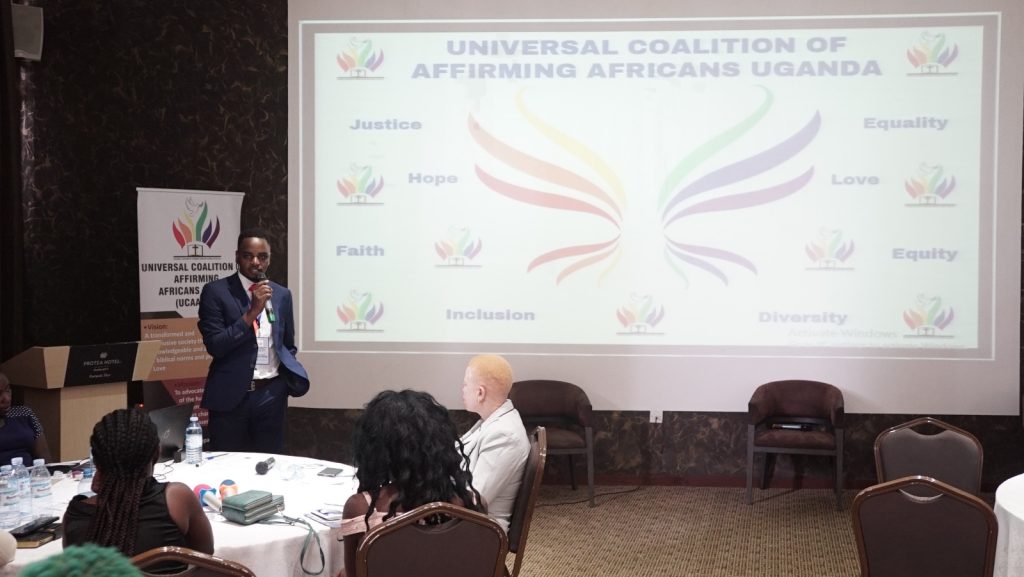
“Diverse mix of voices leads to better discussions, decisions and outcomes for everyone” Sundar Pichai. I feel like today we have a perfect diverse group to discuss with and I cannot not open my ears wide ready to listen to what everyone’s thoughts are.
My name is Tom Twongyeirwe, I am the National coordinator at the Universal Coalition of Affirming Africans Uganda. Founded in 2017, UCAA was the first organisation established to progress religious inclusion for LGBTQ+ communities through awareness, advocacy, and thought-provoking dialogues.
The topic for today’s dialogue is made up of three important words that you see on the screen. Religion, Diversity, and Inclusion. We are all gathered here today, to talk through the relationship between the three, how they influence each other and the impact the combination of the three has on our society.
Religion: I am pretty sure that both me and you have either heard, learnt, or believe that religion is and should be a place that welcomes the downtrodden and a refugee to those who cannot find refuge in any other place in the world. The question of whether religion is practically fulfilling this theory is to be answered by you through this discussion today.
Diversity: Our Ugandan society is diverse in nature, it’s made up of different tribes, the Baganda, the bakonjo, the bafumbila, the balulwala, the bakiga, the bagisu name it! The tribes are also made up of different kinds of people; the transgender, the gay, the bisexual, politicians, religious leaders name it!. Some people believe in religion, others don’t, some people believe in traditional gods, others don’t. Some people are dark, brown, short, tall, chocolate skin name it!
Inclusion: Have you ever realised that these differences above are what makes us unique and special as human beings? But on the other way round, the same differences are what some people use against each other, to torture them, discriminate against them, mock them take away their human rights. People can be judges, juries and execution all wrapped in the same envelope against others.
There are many vulnerable groups in this country, but there is that one group of people that have suffered the most consequences. That group of people is the reason as to why we are here today, and that is: the LGBTQ+ community. We have just heard of Mathew, who was stabbed to death a week ago, she had a life, she had friends, she had dreams and she deserved to live. And that’s just the most recent case, it’s been happening, some are known, others are not. There is glass ceiling in our society for LGBT+ people, for instance a mere suspect in school is equal to students’ expulsion. Even those who have made it, have made their train by the skin of their teeth. The only thing that separates LGBT+ people from everyone else especially in this country is opportunity, the opportunity to live, the opportunity to live true self, the opportunity to showcase what we can do. To be fair, even the smiles you see on our faces is because we decide not to give up, but we choose to tighten our seatbelts and enjoy the ride even if the road is so bumpy, because you cannot wait until life is not hard anymore, before you decide to be happy.
While the injustices are happening, we need collaborative efforts to make change happen and Religion which is both theoretically and practically driven by the principles of equality and love for all should be at the forefront of this fight. Religion seems to be comfortable raising their voices against injustices on other vulnerable groups but seems to be hesitant when it comes to LGBTQ+ people. Not sure if “the love for all” principle is discriminative. If change is to happen, when does it have to happen, do we have to wait until people can’t stop killing each other? because truth be told, the next person on the line, could be your friends, your relative, you child or anyone you know. Change begins with us.
Now, our question today should be does Religion in our beautiful Christian country embrace the diverse nature of our society, and if it does, what is its role in ensuring that all our differences are accepted and respected? We may not like talking about it, but it does happen which means that the discussion needs to happen, and it needs to happen now!
Homophobia is built into the DNA of some people and as long as we turn a Blind eye to the pain of those who are suffering its oppression, we will never escape these origins.
I would like you to ponder about two questions as we discuss:
- Is this the Uganda you really want to live in, where money is more important than humanity, where criminality is confused with mental health and where people are killed because they just want to live their true authentic?
- In your respective department and offices, be in law enforcement, healthy sector, politics, religion, journalism, and civil society, to what extent are you leading with love?
I do not have answers to these questions, but we all have a role to play and it’s you to decide whether you stand with the oppressed or the oppressor.
I wish you a splendid discussion. Thank you very much.
Read MoreUCAA STRATEGIC COMPASS 2024-2028
We are a network of inclusive faith leaders, people of faith and faith based organisations established in 2017 to advocate for the rights of vulnerable and marginalized persons in Uganda.
We use a faith-based approach to advocate for the inclusion of marginalised persons. That is, we generate knowledge on the interlink between faith and human rights and use it to advocate for the rights of marginalized groups, build the capacity of communities, faith leaders and other stakeholders, psychosocial support and social economic empowerment.
Read MoreSTRATEGIC DIRECTION 2024-2028
The overall change we want to see is “Empowered marginalised persons enjoying their human rights in an inclusive society.” The ability of marginalized groups to fully enjoy their human rights is a function of their capacity to influence change in the mindsets of faith and religious leaders, duty…
Read More